
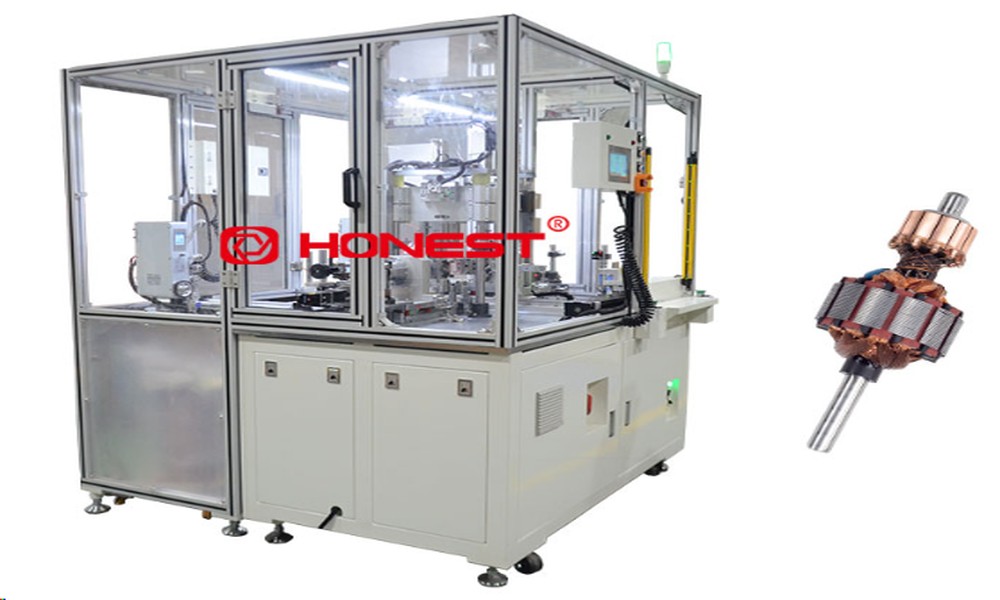
The rapid growth of electric vehicles, renewable energy systems, and industrial automation has transformed the electric motor manufacturing industry. As demand for high-efficiency motors continues to rise, manufacturers are focusing on advanced production technologies that deliver greater precision, speed, and reliability. One of the most important stages in hairpin-based motor production is conductor shaping, where copper wires are formed into precise geometries. This process is handled by the hairpin forming machine, a critical piece of equipment in modern motor manufacturing.
Hairpin forming technology has evolved significantly in recent years, enabling manufacturers to produce highly accurate copper conductors at large scale. These innovations are essential for supporting the production of next-generation electric motors used in electric vehicles and other high-performance applications.
The Role of Hairpin Forming in Motor Production
Hairpin forming refers to the process of shaping rectangular copper conductors into predefined hairpin structures used in stator windings. These conductors must meet strict dimensional requirements to ensure proper insertion, alignment, and welding within the motor stator.
A hairpin forming machine automates this process by precisely bending, shaping, and preparing copper wires according to motor design specifications. This ensures that every hairpin produced is consistent in size and geometry, which is essential for achieving high motor efficiency and performance.
Without accurate forming, downstream processes such as insertion and welding may be affected, leading to reduced motor reliability and efficiency. Therefore, hairpin forming is one of the foundational steps in modern motor production.
Innovations in Hairpin Forming Machine Technology
Recent advancements in hairpin forming machine technology have significantly improved production efficiency and accuracy. Modern systems are designed with high-precision servo controls, automated feeding mechanisms, and intelligent monitoring systems that ensure consistent output quality.
One of the most important innovations is the use of servo-driven bending systems. These systems allow precise control over bending angles and shaping parameters, ensuring that each hairpin meets exact specifications. This level of accuracy is essential for high-performance electric motors, particularly in electric vehicle applications.
Another major innovation is the integration of automated calibration systems. These systems continuously monitor forming accuracy and make real-time adjustments to maintain consistency throughout production runs.
Importance of Precision in Hairpin Forming
Precision is critical in hairpin forming because even small deviations in conductor shape can affect motor assembly and performance. If a hairpin is not accurately formed, it may not fit properly into the stator slots, leading to assembly difficulties or performance issues.
A high-quality hairpin forming machine ensures tight dimensional tolerances and repeatable accuracy. This improves downstream manufacturing processes and reduces the likelihood of defects in the final motor product.
Precision forming also contributes to better electrical performance by ensuring proper alignment and connection of conductors within the stator. This helps reduce resistance and improve overall motor efficiency.
Automation in Hairpin Forming Processes
Automation has revolutionized hairpin forming by increasing production speed and consistency while reducing manual labor requirements. Modern machines are capable of performing multiple operations automatically, including wire feeding, straightening, cutting, bending, and shaping.
Automated systems ensure that each stage of the forming process is executed with high accuracy and repeatability. This reduces variability and improves overall product quality.
In high-volume production environments, automation is essential for meeting the growing demand for electric motors used in electric vehicles and industrial applications.
Key Features of Advanced Hairpin Forming Machines
Modern hairpin forming machine systems are equipped with advanced features designed to improve efficiency, precision, and reliability.
High-Precision Servo Control Systems
Servo-driven mechanisms provide accurate control over bending and shaping operations. This ensures consistent hairpin geometry across large production batches.
Intelligent Process Monitoring
Real-time monitoring systems track production performance and detect any deviations in forming accuracy. This helps maintain consistent quality standards.
Flexible Production Capabilities
Advanced machines can handle different wire sizes and geometries, allowing manufacturers to produce a variety of hairpin designs using a single system.
High-Speed Operation
Modern forming machines are designed for high-throughput production, enabling manufacturers to meet large-scale industrial demands efficiently.
Automated Quality Control
Integrated inspection systems verify the accuracy of each formed hairpin, reducing defects and improving overall production efficiency.
Applications in Electric Vehicle Manufacturing
Electric vehicles are one of the primary drivers of hairpin forming machine adoption. EV motors require highly efficient and compact designs, which depend on precisely formed copper conductors.
Hairpin forming ensures that each conductor is accurately shaped for optimal insertion into the stator. This improves motor efficiency, enhances thermal performance, and supports high-power output requirements.
As EV production continues to grow globally, demand for advanced forming technologies will continue to increase.
Role in Industrial and Renewable Energy Systems
Beyond electric vehicles, hairpin forming machines are widely used in industrial automation and renewable energy systems. Industrial motors require high reliability and efficiency, which depend on precise conductor shaping.
Renewable energy applications, such as wind turbines and energy storage systems, also rely on high-quality motor components. Accurate hairpin forming helps ensure long-term performance and operational stability.
These industries benefit significantly from the efficiency and consistency provided by modern forming technologies.
Challenges in Hairpin Forming
Despite technological advancements, hairpin forming still presents several challenges. Achieving consistent accuracy across different conductor sizes and materials can be complex.
Maintaining high-speed production while ensuring precision requires advanced control systems and regular calibration. Additionally, variations in copper material quality can affect forming performance.
Modern hairpin forming machine solutions address these challenges through automation, real-time monitoring, and intelligent adjustment systems.
Benefits of Modern Hairpin Forming Machines
The adoption of advanced hairpin forming technology provides several key benefits for manufacturers.
Improved accuracy ensures better motor assembly and performance. Higher production efficiency allows manufacturers to meet growing demand without sacrificing quality.
Reduced labor requirements and lower defect rates contribute to cost savings and improved operational efficiency. Additionally, automation enhances consistency, which is critical for large-scale production environments.
These advantages make modern forming machines essential for competitive motor manufacturing.
Future Trends in Hairpin Forming Technology
The future of hairpin forming machines is closely tied to advancements in automation, artificial intelligence, and smart manufacturing systems.
AI-driven control systems are expected to enhance precision and optimize forming parameters in real time. Predictive maintenance technologies will help reduce downtime and improve machine reliability.
Integration with fully automated motor production lines will further streamline manufacturing processes, enabling end-to-end automation from wire feeding to final motor assembly.
As electric motor technology continues to evolve, hairpin forming machines will become even more advanced, efficient, and intelligent.
Conclusion
The hairpin forming machine plays a vital role in modern electric motor manufacturing by ensuring precise and consistent shaping of copper conductors. As industries continue to adopt electrification and high-efficiency motor systems, the importance of advanced hairpin forming technology continues to grow.
Through innovations in automation, servo control, and intelligent monitoring, modern forming machines deliver the precision and efficiency required for large-scale production. These advancements help manufacturers improve motor performance, reduce costs, and meet the increasing global demand for electric vehicles and industrial motor systems.
Hairpin forming technology will remain a key component of future motor manufacturing, supporting continued innovation and growth across multiple industries.