
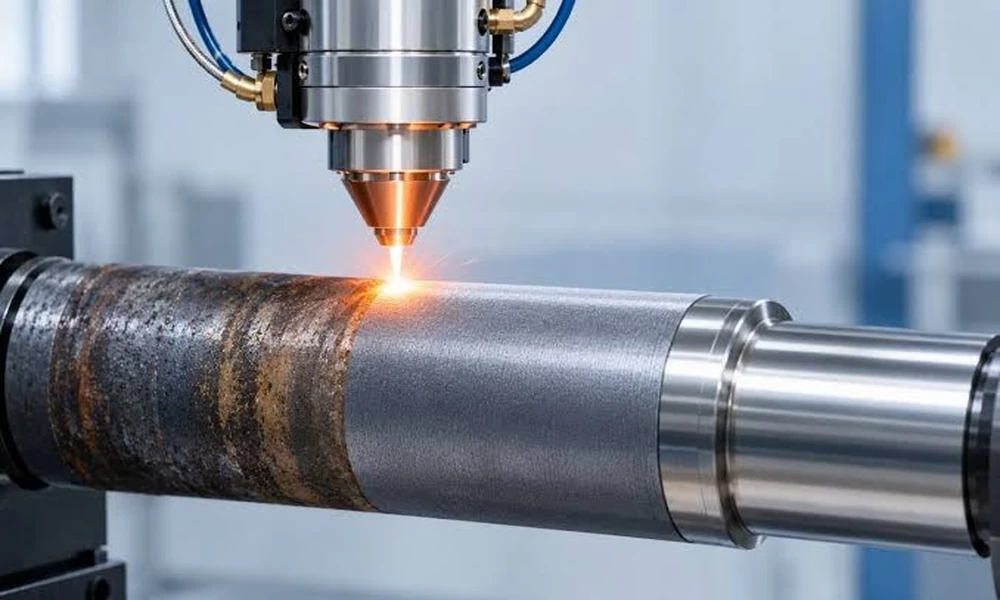
Every plant has one shaft or valve seat that wears out faster than anything around it. A pump shaft in a slurry line, a gate valve in a steam system, a roller on a steel mill conveyor: each loses metal at a time until it no longer seals, spins true or holds its tolerance. For decades, the answer was to scrap it or rebuild it by hand. Robotic laser cladding offers a third route, adding a dense, hard-wearing alloy layer exactly where the wear happens and almost nowhere else.
The idea is simple enough to explain over a cup of tea. A focused laser beam melts a thin skin of the part surface along with a stream of metal powder or wire, and the two fuse into a fresh layer as the beam moves on. Mount that beam on a robot arm, and you get repeatable tracks, steady overlap and the freedom to follow curved or awkward shapes. That combination is why laser cladding has moved from research labs into everyday maintenance workshops.
What Actually Happens During the Laser Cladding Process?
The laser cladding process starts long before the laser switches on. The worn area is machined to remove fatigued metal, cracks and old coatings, then cleaned so that grease or oxide cannot contaminate the melt. The part is mounted on a turntable or positioner, and the robot is given a path that covers the zone in overlapping beads, a bit like mowing a lawn in neat strips.
As the head travels, powder is blown into a small melt pool created by the beam. The pool solidifies within a fraction of a second, so heat stays local. Several layers can be stacked to restore lost dimensions, and the part then returns to the lathe or grinder for final sizing. A sound laser cladding process is as much about careful preparation and finishing as the moment of melting.
How Is Laser Cladding Different from HVOF Thermal Spray?
HVOF (high velocity oxygen fuel) spraying has protected parts for many years. HVOF fires semi-molten particles at very high speed, and they flatten and lock onto a roughened surface, which gives a mechanical bond. Laser cladding melts a thin layer of the base metal together with the new alloy and creates a metallurgical bond, so the coating becomes part of the component and is far less likely to peel or chip under impact.
Thickness differs, too. HVOF coatings typically measure in fractions of a millimeter, ideal for thin, very hard carbide surfaces on hydraulic rods or pump sleeves. Laser cladding technology can build layers of a millimeter or more, so it suits heavily worn diameters that must be restored. When you compare proposals from HVOF coating companies and cladding workshops, the useful question is which wear problem you are trying to solve.
Two more terms matter here. Dilution is how much base metal mixes into the clad layer, and too much of it weakens the coating chemistry. Because the energy is tightly focused, laser cladding keeps dilution low compared with arc-welded overlays. The heat-affected zone, the band of base metal altered by heat, also stays narrow, which lowers the risk of distortion and cracking.
Why Does Robotic Path Control Matter So Much?
A skilled welder still gets tired, and hand speed drifts over a long shift. With robotic laser cladding, travel speed, laser power, powder feed and bead overlap are held steady from the first track to the last. That consistency shows up as even thickness, fewer pores and a smaller machining allowance, saving alloy and lathe time.
Robots also reach places hands struggle with. Offline programming lets engineers plan paths on a 3D model of the part, so complex profiles such as extruder screws, turbine blade edges or valve seats can be clad with the same care as a plain shaft. Some providers of laser cladding services also use slim heads that travel inside bores and pipes, coating internal surfaces that a torch could never reach properly.
Which Alloys Pair Well with Laser Cladding Technology?
The right powder depends on how the part fails. Cobalt-based alloys handle heat, galling and sliding wear in valve seats and hot-working tools. Nickel-based alloys resist corrosion in chemical, marine and oil and gas service. Blends of tungsten carbide in a nickel matrix take on abrasion, common in mining and cement plants. Laser cladding technology handles all of these well, since the small, controlled melt pool lets carbide particles survive with less breakdown than many arc processes allow.
Typical jobs handled by laser cladding services include:
- Pump and compressor shafts with worn bearing or sealed journals.
- Valve gates, seats and stems in oil, gas and power plants.
- Crusher parts, drilling tools and slurry handling components in mining.
- Hydraulic rods and process rollers exposed to corrosion and abrasion.
Is It Smarter to Repair a Worn Part or Clad a New One?
Repair is where laser cladding first proved its worth. A large pump shaft or forged valve body can take months to replace. Cladding the worn zone and machining it back to size often returns the part within days, and the restored surface can outlast the original when a tougher alloy is chosen.
New parts gain as well. Some producers make a component from ordinary carbon steel and clad only the faces that see wear or corrosion, so the whole part need not be made from a costly alloy. That approach suits robotic laser cladding nicely, because the same robot path can run on every part in a batch.
Cost depends on part size, the area to be clad, layer thickness, the alloy chosen, fixturing, and how much preparation and finishing the job requires. When weighing a cladding quote against offers from HVOF coating companies, ask about bond checks, hardness testing, dye penetrant or ultrasonic inspection, and how final thickness is measured. Those answers reveal far more about quality than any brochure.
Is Laser Cladding Worth for Older Equipment?
For most heavy, slow-to-replace parts it is, provided the base metal is sound, and the wear mechanism is clearly understood. Robotic laser cladding gives ageing shafts, valves and rollers a hard, fully bonded surface with very little heat damage, which often stretches the time between overhauls. Keep a simple record of how each part fails, share drawings and operating conditions with the workshop, and ask for a trial coupon before committing a full batch. That small step makes it much easier to judge how well the laser cladding process fits your plant.
Robotic laser cladding helps restore worn components, improve their durability and extend equipment life. Choosing a reliable thermal spray coating services depends on the type of wear, operating conditions and protection the component needs for long-term performance.