
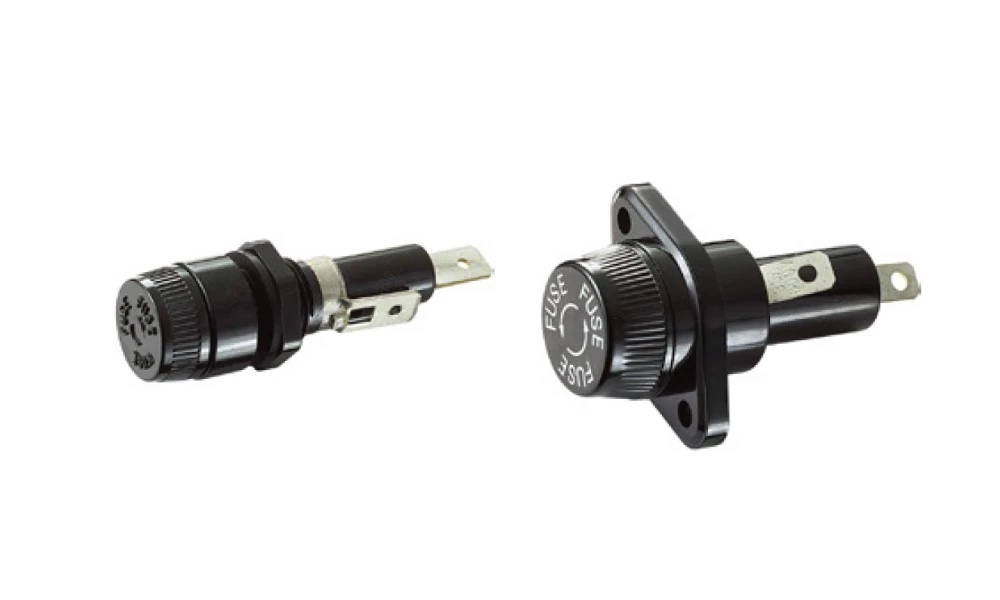
Overcurrent protection is a fundamental requirement of any electrical circuit, and the fuse holder is the mechanical interface that connects the fuse to the circuit while allowing safe, tool-free or minimal-tool replacement of the fuse element when it operates. Selecting the correct fuse holder for the circuit voltage, current, fuse type, and the environmental conditions of the installation is as important as selecting the fuse itself: a mismatched or poor-quality holder creates contact resistance that causes heating, prevents proper fuse seating that creates intermittent protection, and may fail to safely contain the arc energy when the fuse operates under fault conditions. Understanding what fuse holder manufacturers supply and how to evaluate fuse holders for specific applications helps electrical engineers and procurement teams make reliable component selections.
What is a fuse holder and what does it do?
A fuse holder is an electrical component that mechanically and electrically connects a fuse element to the circuit it protects. The holder provides the contact surfaces that carry the circuit current through the fuse, the mechanical retention that keeps the fuse correctly positioned during normal operation, and the access mechanism that allows the fuse to be removed and replaced when it operates or when the circuit requires maintenance.
The functional requirements of a quality fuse holder include:
- Low contact resistance: the contact surfaces of the fuse holder must make consistent, low-resistance electrical contact with the fuse terminals across the rated current range and across the operating temperature of the installation. Contact resistance that increases over time, due to oxidation, contamination, or mechanical wear, produces heating that can damage the holder and the adjacent wiring before the fuse operates on the fault the holder is designed to address.
- Correct fuse sizing: the holder must physically accept the fuse type and size specified for the circuit, with the contact spacing and mechanical retention designed for the specific fuse standard. Attempting to use a fuse in a holder not designed for it creates contact quality and safety issues regardless of the fuse’s rating.
- Voltage and current rating: the holder’s voltage and current rating must equal or exceed the circuit parameters. The voltage rating of the holder is particularly important for AC circuits and for DC circuits at elevated voltages where arc interruption on holder opening requires adequate creepage and clearance distances.
- Environmental protection: for holders installed in enclosures subject to moisture, dust, or chemical exposure, the sealing and housing material of the fuse holder must provide the ingress protection appropriate to the installation environment
What is an FH1 fuse holder?
The FH1 fuse holder designation refers to a specific category of panel-mount fuse holder designed for the 5x20mm glass or ceramic cartridge fuse, one of the most widely used fuse formats in electronics, control circuits, and low-current industrial applications. The FH1 fuse holder is typically a cylindrical body that accepts the 5x20mm fuse cartridge, with a threaded cap or bayonet closure that retains the fuse in position and provides the circuit connection through the cap contact.
FH1 fuse holders are specified across a wide range of applications:
- Electronic equipment and control panels: the 5x20mm fuse and FH1 fuse holder combination is the standard overcurrent protection approach for PCB-level and panel-level protection of control circuits, instrumentation, and low-power electronic equipment.
- Automotive and vehicle electrical systems: the compact form factor and the available current ratings of the FH1 fuse holder make it appropriate for auxiliary circuit protection in commercial vehicles, construction equipment, and specialist vehicle electrical systems.
- Industrial control enclosures: control panel designers use FH1 fuse holders for protection of 24VDC control supply circuits, PLC input/output power supplies, and the signal conditioning and communication circuits whose protection requirements fall within the 5x20mm fuse current range.
What should procurement teams evaluate in fuse holder suppliers?
When selecting from the available fuse holder suppliers and fuse holder manufacturers in India, the evaluation criteria that matter most include:
- Standards compliance: the holder’s compliance with IEC 60127 for miniature fuse holders and the applicable BIS standard for holders used in products sold in the Indian market, with the documentation to support compliance claims.
- Contact material and plating: the contact material and surface treatment of the fuse holder‘s contact surfaces determine the contact resistance stability over time. Silver-plated or tin-plated brass contacts maintain lower resistance than unplated contacts in most installation environments.
- Thermal performance: the holder’s ability to carry the rated current continuously without excessive temperature rise, which is the parameter most directly relevant to long-term reliability in loaded circuits.
- Availability and consistency of supply: fuse holders are high-volume, frequently replaced components in production and maintenance contexts. Consistent supply from a reliable fuse holder supplier is a practical procurement requirement alongside the technical specification.
Conclusion
The fuse holder, whether a standard FH1 fuse holder for miniature cartridge fuse applications or a larger panel-mount or in-line holder for higher-current circuits, is a component whose quality directly affects the reliability of the overcurrent protection system it supports. Selecting fuse holders from quality fuse holder manufacturers with the correct ratings, material quality, and standards compliance for the specific application is the foundation of a reliable protection system.
Electronic components suppliers in India provide fuse holders including FH1 fuse holders and a range of panel-mount and in-line fuse holder configurations for industrial, commercial, and OEM applications. Suppliers can provide holders according to the voltage, current, and environmental rating requirements of each application, along with the quality documentation and consistent supply that professional electrical procurement requires.
